When people discuss anti-aging, the first things that come to mind are often collagen, antioxidants, or wrinkle reduction. However, wrinkles are merely the visible outcome of aging, not the root process itself. With recent advancements in cutaneous biology, we now recognize that skin aging is not driven by a single isolated factor, but is a complex, multi-factorial process involving neuro-regulation, structural support degradation, oxidative damage, and declines in cellular vitality.
Different signs of aging invariably correspond to distinct underlying biological mechanisms. Therefore, a truly effective anti-aging strategy should transcend single-ingredient or single-metric frameworks. Instead, it must establish a systemic suite of solutions tailored to diverse aging pathways.
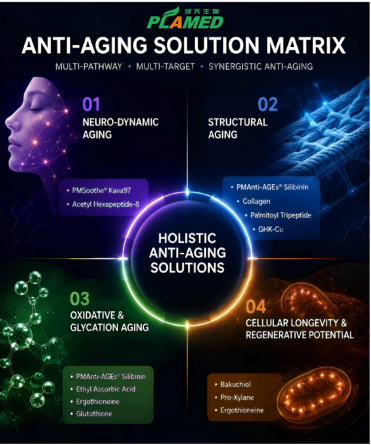
Driven by this insight, Plamed addresses the key mechanisms of skin aging by building a multi-dimensional anti-aging solution framework. This framework targets four core directions: Neural Dynamic Aging, Structural Aging, Oxidative & Glycation Aging, and Cellular Longevity & Regenerative Potential. Through the development of innovative active ingredients, we provide more scientific and comprehensive anti-aging solutions for global brands.
I. Neuro-Dynamic Aging
Understanding How Expression Lines Gradually Transition into Permanent Wrinkles
Long before wrinkles become permanently visible on the surface, they have already begun to form underneath. Crow’s feet, forehead lines, and frown lines are typically among the earliest signs of aging. Initially, these lines do not stem from collagen loss; instead, they are caused by continuous neural signals that stimulate muscle contractions, leading to repeated skin creasing. Youthful skin possesses robust biomechanical resilience, allowing these creases to bounce back quickly. However, as age progresses, this regenerative capacity declines, causing dynamic lines to become permanently etched into the skin matrix as visible, deep wrinkles.
Currently, most solutions for dynamic wrinkles primarily target the release of acetylcholine. For instance, by interfering with the formation of the SNARE complex to reduce neurotransmitter release, thereby weakening muscle contractions. However, neuromuscular contraction is not a single-step event but a continuous process involving multiple critical nodes. From the initiation of the neural signal to the final muscle contraction, every single stage can influence ultimate wrinkle formation.
What Plamed Discovered
Through in-depth research into the neuromuscular dynamic pathway, Plamed further discovered that beyond acetylcholine release, Ca2+ influx, VAMP2-mediated vesicle fusion, and myosin-driven contraction are equally critical stages influencing the formation of dynamic lines. This means that dynamic wrinkle management can be upgraded from single-point intervention to systemic regulation of the entire neural dynamic process.
Based on this discovery, we began to ponder: if we could simultaneously act on multiple key nodes, could we achieve a more comprehensive approach to dynamic wrinkle management? Consequently, we expanded our research focus from single-point inhibition to the systemic regulation of the entire neuromuscular dynamic cascade.
Plamed Innovation:
PMSoothe® Kava97
During this research journey, Plamed found the immense potential of PMSoothe® Kava97 in the field of neural dynamic anti-aging. Studies demonstrated that Kava97 can synergistically regulate multiple critical steps in the neuromuscular contraction pathway, effectively reducing the formation of expression lines caused by excessive muscle contractions (Figure 1).
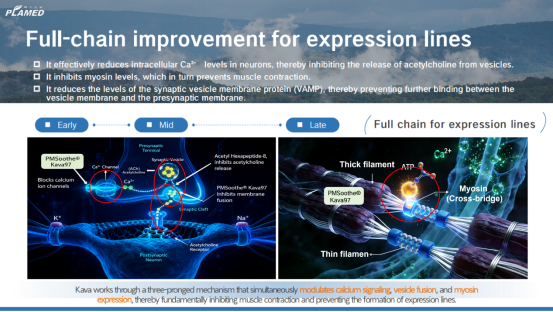
Figure 1: PMSoothe® Kava97 Full-Chain Improvement for Expression Lines
- Level 1: Source Regulation: Intracellular Ca2+ levels in neurons are reduced by 30%, weakening neural excitation signals at the source.
- Level 2: Release Regulation: VAMP2 protein expression is decreased by 19.57%, inhibiting vesicle fusion and lowering neurotransmitter release efficiency.
- Level 3: Contraction Regulation: Myosin expression is reduced by 53%, weakening muscle contraction capacity by lowering the ATP energy supplied for contraction (Figure 2).
Efficacy Validation: Acetylcholine release is reduced by 7.54%.
In Vivo Testing: A noticeable improvement in crow’s feet can be observed after 7 days, with the clinical efficacy further enhanced after 14 days (Figure 3). This discovery opens up a pioneering paradigm for neural dynamic anti-aging.
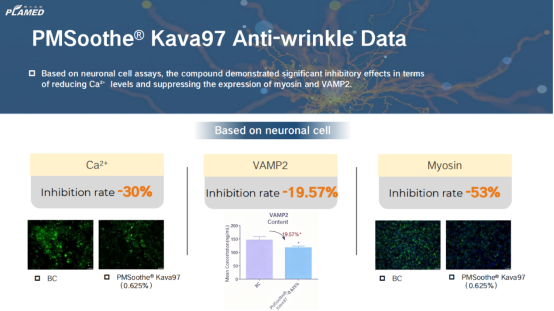
Figure 2: PMSoothe® Kava97 Anti-wrinkle Data
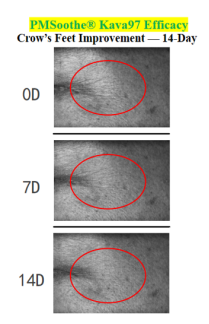
Figure 3: Crow’s Feet Improvement Case Studies
Acetyl Hexapeptide-8
To facilitate a more comprehensive dynamic wrinkle solution, Plamed has developed and manufactured Acetyl Hexapeptide-8 in a 99% high-purity powder form (distinct from the low peptide versions in the market). This raw material mimics the SNAP-25 peptide fragment to competitively inhibit the formation of the SNARE complex, thereby reducing acetylcholine release.
While Acetyl Hexapeptide-8 blocks the complex, Kava97 targets VAMP2 and its upstream dynamic processes. Together, they possess a natural, multi-target complementary effect in inhibiting vesicle fusion (Figure 4).
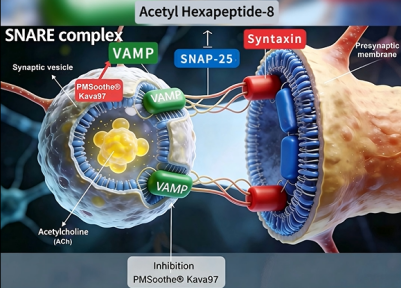
Figure 4: Complementary Inhibitory Effect
II. Structural Aging
Maintaining ECM Homeostasis and Structural Support for the Skin
The key to young skin is far more than just collagen. As we age, collagen, elastic fibers, and the dermal-epidermal junction (DEJ) structure within the skin gradually degenerate. This ultimately manifests as skin sagging, drooping facial contours, and the deepening of static wrinkles. While collagen has long been regarded as the gold standard benchmark for anti-aging, the architecture of the skin is vastly more intricate than just a single type of collagen protein.
Many anti-aging products on the market remain hyper-focused on boosting collagen content. However, maintaining youthful skin depends not only on standalone collagen levels but also on the integrity of the entire Extracellular Matrix (ECM, Figure 5). The ECM encompasses not just collagen, but also elastin, fibrillin, hyaluronic acid-associated networks, and the dermal-epidermal junction (DEJ) system. Together, these structures form the vital structural support network of the skin.
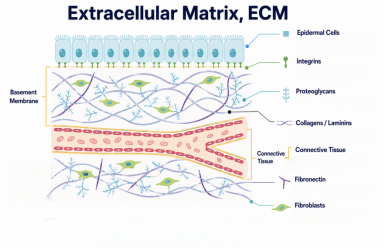
Figure 5: Diagram of ECM Structure in the Skin
What Plamed Discovered
Research indicated that compared to individual collagen metrics, the overall ecological stability of the ECM provides a much more accurate reflection of the skin’s true youthful state. Consumers do not perceive changes in an isolated type of collagen; rather, they experience the holistic structural performance of their skin.
Consequently, Plamed has shifted its research focus from merely “increasing collagen” to “maintaining ECM homeostasis.” To support this, we have established a comprehensive ECM matrix validation system that covers collagen, elastin, DEJ structures, and hyaluronic acid-related indicators.
Plamed Innovation:
PMAnti-AGEs® Silibinin (PMAnti-AGEs® Silibinin80 & PMAnti-AGEs® Silibinin98)
Under this research framework, Plamed screened and investigated Milk Thistle Extract. Existing studies show that Silybin is one of the most valuable core active components of Milk Thistle Extract. Compared to other actives of Milk Thistle Extract, silibinin exhibits superior efficacy in scavenging ROS and regulating the inflammatory cytokine TNF-α. Plamed focuses not just on milk thistle extract as a whole, but precisely on the specific active component driving the efficacy. Therefore, we established a silibinin-centric research program dedicated to purity control, isomer ratio management, efficacy validation, and formulation application. To meet diverse product development needs, we have designed two representative solutions:
- PMAnti-AGEs® Silibinin98: A 98% high-purity silibinin. This grade focuses on high purity, isomer ratio control, and batch-to-batch stability. By simultaneously monitoring the content of Silibinin A and Silibinin B, we ensure a highly stable and predictable performance of the raw material.
- PMAnti-AGEs® Silibinin80: An 80% standardized silibinin. As Plamed’s flagship product for milk thistle efficacy validation, it has undergone a systematic ECM matrix evaluation covering four dimensions: collagen, elastin, DEJ architecture, and hyaluronic acid. The results reveal a significant upgrade across all 11 key ECM benchmarks (Figures 6 & 7). Notably, at a concentration of 0.2%:
Collagen XVII: ↑ 355.56%
HABP (Hyaluronic Acid Binding Protein): ↑ 317.39%
Collagen I: ↑ 290.91%
Elastin: ↑ 230.30%
Plamed believes that compared to boosting a single type of collagen, maintaining the ecological stability of the ECM is a better reflection of long-term skin structural health. Thus, anti-aging is not merely about topically supplementing collagen from the outside; it is fundamentally about stabilizing the ECM ecosystem from within.
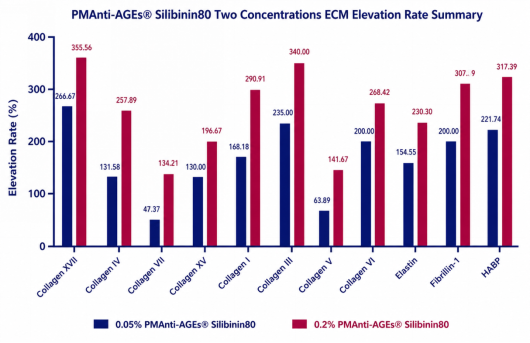
Figure 6: ECM Up-regulation Rates of PMAnti-AGEs® Silibinin80 at Two Concentrations
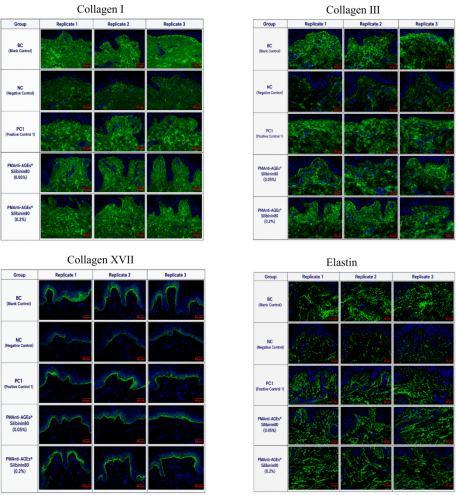
Figure 7: Immunofluorescence Results for Collagen I / III / XVII and Elastin
Note: Blue fluorescence indicates cell nuclei; green fluorescence represents Collagen I/III/XVII and Elastin. Stronger green fluorescence indicates a higher protein content.
Complementary Solution Matrix
To assist brands in constructing a comprehensive structural anti-aging portfolio, Plamed concurrently offers:
- Recombinant Collagen: Provides structural support and helps maintain the integrity of the dermal network.
- Palmitoyl Tripeptide-1: A classic messenger peptide involved in regulating the expression of ECM-related proteins.
- Palmitoyl Pentapeptide-4: Supports the maintenance of the collagen network and enhances skin structural performance.
- Copper Tripeptide-1 (Blue Copper Peptide): Participates in skin repair and structural renewal via a copper ion carrier mechanism.
- Palmitoyl Tetrapeptide-7: Supports a healthy skin environment and long-term structural management.
III. Oxidative & Glycation Aging
Combating Invisible Aging Damage Beneath the Surface
Some forms of aging do not originate with wrinkles. By the time wrinkles, sagging, or dropping facial contours become visible, internal damage has already taken root deep within the skin. Specifically, oxidative damage and glycation are recognized as major catalysts driving skin aging. Prolonged exposure to UV radiation, pollution, psychological stress, and high-sugar diets causes the skin to continuously generate excess Reactive Oxygen Species (ROS), disrupting normal cellular functions. Simultaneously, non-enzymatic reactions between sugars and proteins lead to the gradual accumulation of Advanced Glycation End-products (AGEs). Though invisible to the naked eye, these microscopic alterations steadily erode the skin’s capacity to maintain its youthfulness.
Historically, anti-aging research heavily focused on free radical scavenging, which saturated the market with antioxidant active ingredients. However, a growing body of evidence reveals that glycation also inflicts continuous damage on skin structures. The accumulation of AGEs causes collagen fibers to become rigid and brittle, impairs the function of elastic fibers, and accelerates the degradation of the skin’s supporting framework. Therefore, oxidative stress and glycation do not occur in isolation, they eventually undermine the stability of the skin’s structural system.
What Plamed Discovered
Whether driven by oxidative stress or glycation, the ultimate casualty is the Extracellular Matrix (ECM). Oxidation accelerates the degradation of structural proteins, while glycation compromises their functionality, both leading to an ecological imbalance within the ECM. Based on this understanding, Plamed maintains that true anti-aging should transcend mere free radical scavenging and isolated anti-glycation metrics. The ultimate goal must be helping the skin preserve a healthy ECM ecosystem. Consequently, during our research into milk thistle extract, we carefully evaluated its protective value against both oxidative and glycation damage.
Plamed Innovation: PMAnti-AGEs® Silibinin
As a cornerstone efficacy milestone of Plamed’s milk thistle extract research, PMAnti-AGEs® Silibinin80 demonstrates exceptional anti-glycation performance alongside its ability to maintain ECM homeostasis.
In an AGEs (CML) evaluation model:
- At a 0.05% concentration, the inhibition rate reaches 73.89%.
- At a 0.2% concentration, the inhibition rate reaches 82.60%.
This demonstrates outstanding capability in managing glycation-induced damage (Figure 8). Furthermore, in a UV-induced photoaging model, PMAnti-AGEs® Silibinin80 successfully preserves the expression of key ECM proteins: at a 0.05% concentration, Collagen I increased by 168.2% and Collagen III increased by 235%. This dual antioxidant and anti-glycation value offers powerful, comprehensive protection for the ECM.
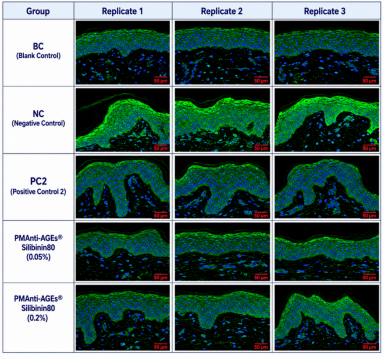
Figure 8: Immunofluorescence Results for AGEs (CML)
Note: Blue fluorescence indicates cell nuclei; green fluorescence represents AGEs (CML). Stronger green fluorescence indicates a higher content of AGEs (CML).
Complementary Solution Matrix
To enable brands to formulate comprehensive oxidative stress and glycation management systems, Plamed also provides:
- Ergothioneine: Enhances cellular resilience against environmental oxidative stress.
- 3-O-Ethyl Ascorbic Acid (Vitamin C Ethyl Ether): A highly stable Vitamin C derivative boasting powerful antioxidant and brightening activity.
- Glutathione: Supports the cell’s endogenous antioxidant defense mechanism.
IV. Cellular Longevity & Regenerative Potential
Supporting Long-Term, Healthy Skin Performance
Some dimensions of aging stem directly from the decline of cellular vitality. When discussing anti-aging, the focus is often placed on surface manifestations like wrinkles, sagging, or uneven skin tone. Behind these visible signs, however, lies a deeper issue: the cells’ intrinsic ability to maintain a youthful state is fading. As time goes on, cellular energy metabolism becomes less efficient, tolerance to environmental stressors weakens, and the renewal cycle slows down. Although these cellular shifts are not immediately apparent, they persistently erode the skin’s long-term vitality.
In recent years, skincare science has steadily pivoted from “improving signs of aging” to “sustaining a youthful state.” Researchers are increasingly focusing on mitochondrial function, cellular energy metabolism, and long-term cellular vitality, as these factors dictate how well skin withstands temporal and environmental challenges. Consequently, Plamed believes that the future of anti-aging competition lies far beyond wrinkle reduction—it is about empowering the skin to maintain a long-term healthy, stable, and vibrant state.
What Plamed Discovered
As anti-aging research advances, a growing number of aging phenomena are found to be intricately linked to cellular energy states and long-term vitality. Therefore, when building our anti-aging solutions, we extend our scope beyond dynamic wrinkles, structural degradation, and oxidative/glycation stress to incorporate cellular-level vitality management. From this perspective, mitochondrial function, oxidative balance, and cellular renewal capacity collectively lay the cornerstone for long-term skin rejuvenation.
Plamed Solutions
To foster more comprehensive, long-term anti-aging regimens, Plamed concurrently provides:
- Bakuchiol: A classic, plant-derived anti-aging active that modulates retinol-like signaling pathways to support collagen expression and youthful skin management without the typical irritation.
- Pro-Xylane (Hydroxypropyl Tetrahydropyrantriol): Supports the dermal-epidermal junction (DEJ) structure, helping maintain the stability of the skin’s support network.
- Ergothioneine: A natural cytoprotective active ingredient that effectively counters oxidative stress to support long-term cellular health.
From Raw Materials to Anti-Aging Solutions
Plamed firmly believes that skin aging is never driven by a single pathway. Instead, it is the collective result of neural dynamic shifts, structural network degradation, oxidative and glycation stresses, and declining long-term cellular vitality. Therefore, a truly effective anti-aging solution must move away from single-ingredient reliance towards a systemic framework that addresses diverse aging mechanisms.
From neural dynamic regulation to structural homeostasis maintenance, and from oxidative/glycation management to long-term cellular vitality support, Plamed is dedicated to helping brands build more scientific, comprehensive, and market-competitive anti-aging systems.
We do more than just supply raw materials; we empower the industry to redefine skin aging.